
Mesh Programming: The Art of Parallel Development

Remember last month when I introduced Mesh Programming? The response was incredible. Today, I want to dive deeper into one of its most powerful aspects: how to plan for parallel development and avoid the dreaded merge conflict hell.
The Traditional Waterfall Trap
Let’s start with a common scenario. Your team needs to add a new feature that spans your entire stack. Traditionally, you might break it down like this:
- Database changes
- Backend API changes
- BFF (Backend-for-Frontend) layer updates
- Frontend React components
Seems logical, right? Each layer depends on the one before it. But this sequential approach has a major drawback: it’s slow. Really slow.
A Real-World Example
Let me share a recent task we faced. We needed to expose a new field on our frontend, pulling data from our backend through our BFF layer. The initial breakdown looked like this:
Create Repository to access backend API (6hrs)Create Service for view model mapping (6hrs)Modify Controller with new view model (6hrs)Build React component to display data (12hrs)Total time: 30 hours of sequential work. That’s almost a full week! But here’s where it gets interesting.
The Mesh Programming Approach
When we applied Mesh Programming principles, we first had our developers draw dependency lines between tasks on the whiteboard. This visual exercise immediately highlighted our bottlenecks.
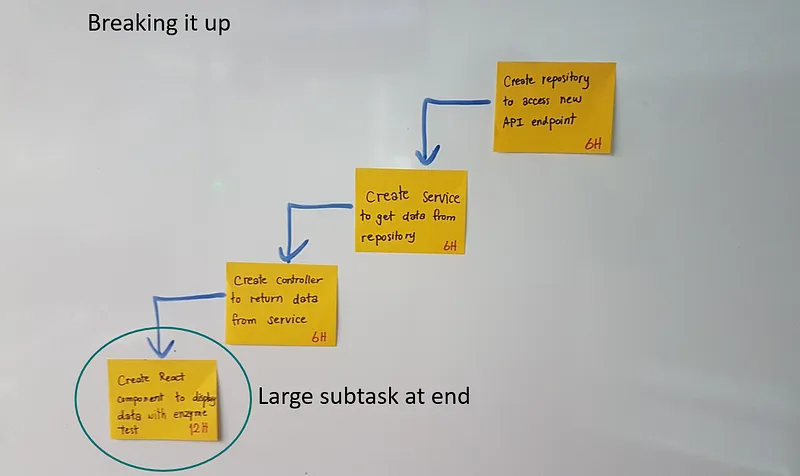
But here’s the key insight: we added one crucial task in the middle that changed everything: “Create controller that returns mock data” (1hr).
This small addition unlocked true parallel development:
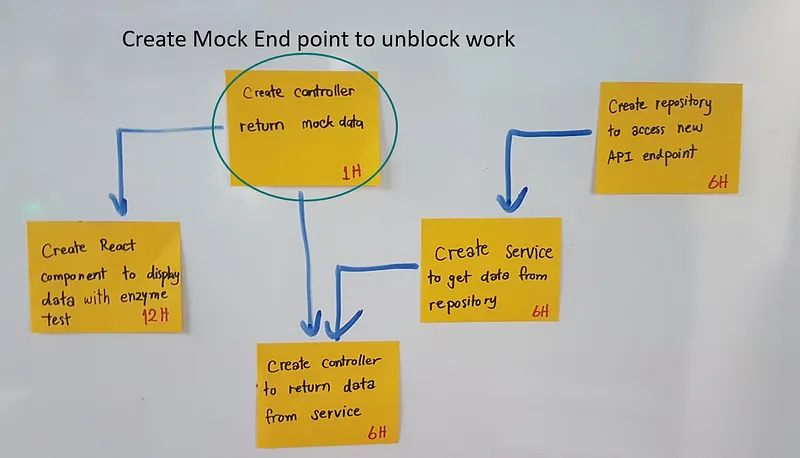
The Secret Sauce: Contract-First Development
The magic happens when two developers pair up initially to create the controller contract — the shape of the data that will flow through the system. This becomes your team’s source of truth.
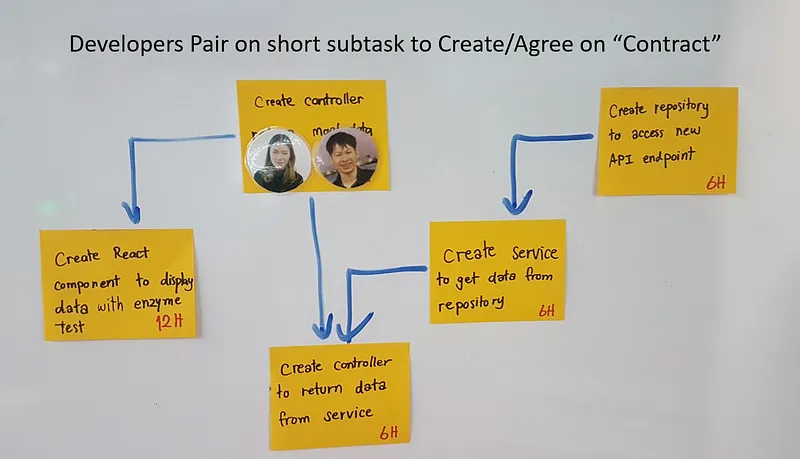
With this contract in place:
- Developers working on Frontend can work against mock data
- Developers working on Backend can implement the real data flow
- Both Devs work on the same branch (yes, you read that right!)
- Last-minute contract changes are easily coordinated
Why This Works
- Reduced Dependencies: By mocking the controller first, we break the rigid dependency chain
- Clear Contracts: The initial pairing session establishes clear interfaces
- Parallel Workflows: Teams can work simultaneously without stepping on each other’s toes
- Faster Integration: Working on the same branch means issues are caught early
- Better Communication: The visual nature of task breakdown promotes discussion
Tips for Getting Started
- Start small. Pick a feature that touches multiple layers but isn’t critical.
- Get your team comfortable with visual planning. Those sticky notes and arrows are crucial.
- Embrace mock data early in the process.
- Trust your developers to work on the same branch.
- Schedule regular (but brief) integration points.
Conclusion
Mesh Programming isn’t just about working in parallel — it’s about working smarter. By focusing on contracts first and enabling parallel development through strategic mocking, we’ve found a way to significantly speed up our development process while reducing conflicts and improving code quality.
Remember: the goal isn’t to eliminate dependencies (that’s often impossible), but to identify and manage them effectively through visual planning and smart task breakdown.
What’s your experience with parallel development? Have you tried similar approaches? I’d love to hear your thoughts in the comments below.
Happy coding! 🚀