
Recognition: The Leadership Skill Nobody Taught You
Or: Why Your Best Engineers Might Be One Missed “Thank You” Away from LinkedIn
There’s a moment every engineering leader dreads. You’re scrolling through LinkedIn on a quiet Tuesday afternoon, and there it is — your best engineer, the one who refactored that nightmare legacy system, the one who mentors three juniors without being asked, posting about how “excited” they are to announce their new role at a company that isn’t yours.
And you wonder: when was the last time you actually told them they mattered?
As the basketball coach John Wooden once observed, “A sincere compliment is one of the most effective tools to teach and motivate others.” Notice he didn’t say “annual performance reviews” or “automated milestone emails.” He said sincere compliments — the kind most engineering leaders were never trained to give, and many feel awkward even attempting.
We’ve optimised everything in modern software development. We’ve got dashboards for deployment frequency, alerts for error rates, metrics for story points (even though we shouldn’t), and Slack bots that celebrate merged PRs. But recognition? That’s still running on a legacy system of good intentions and quarterly surveys nobody reads.
The Thai QA Managers Who Changed How I Think About Feedback
Let me tell you about something that reshaped my understanding of recognition and its ripple effects.
Thai culture is traditionally a polite one — there’s a strong emphasis on harmony, respect for hierarchy, and not causing others to lose face. For years, I’d observed this play out in meetings: thoughtful, capable engineers who would have brilliant insights but rarely volunteer them unprompted. They’d wait to be asked, and even then, hedge their opinions carefully.
But here’s what’s changed: the younger generations are different. I genuinely can’t say enough good things about the interns and graduates I’ve worked with over the past four-plus years. The communication skills, the willingness to challenge ideas respectfully, the comfort with speaking up — it’s been remarkable to witness.
But going back a few years, it was different. And to be clear, this isn’t a Thai problem — I’ve managed shy, hesitant engineers from every country and culture imaginable. Some people are just naturally reserved, regardless of where they grew up.
What caught my attention was a group of QA managers who reported to the same person. In meetings, they were noticeably outspoken and opinionated — they’d challenge assumptions, push back on timelines, advocate for quality when it was inconvenient. It stood out because it was so different from what I’d expected.
So one day, I pulled one of them aside and asked directly: Why? How did you become so outspoken?
His answer was simple and devastating in its implications: “Every time I have a one-on-one with my manager, he’s giving me feedback. He tells me I need to speak up more in meetings and have an opinion. And he doesn’t leave it abstract — he brings me concrete examples of where I missed opportunities. He shows me the exact moment in last week’s meeting where I should have said something but didn’t.”
That’s not annual feedback. That’s not a vague suggestion in a performance review. That’s consistent, specific, constructive recognition of the behaviour you want to see — delivered repeatedly until it becomes habit.
The economist Thomas Sowell wrote that “each new generation born is in effect an invasion of civilization by little barbarians, who must be civilized before it is too late.” The same is true of organisational culture. Every new hire, every promotion, every team restructure is an opportunity for your culture to either strengthen or decay. The behaviours you recognise are the behaviours you’ll see more of. The ones you ignore will quietly disappear.
The Ford Plant Lesson: Recognition at Scale
Here’s where it gets interesting. How do you scale recognition in a large organisation without it becoming performative nonsense?
I had the privilege of visiting a car manufacturing plant, and what I saw there fundamentally changed how I think about hierarchical recognition.
The executive running the tour oversaw multiple plants. His time was extraordinarily limited — every meeting had an agenda, every decision carried weight. You’d think someone at that level would be too busy for individual recognition.
But they’d built a system.
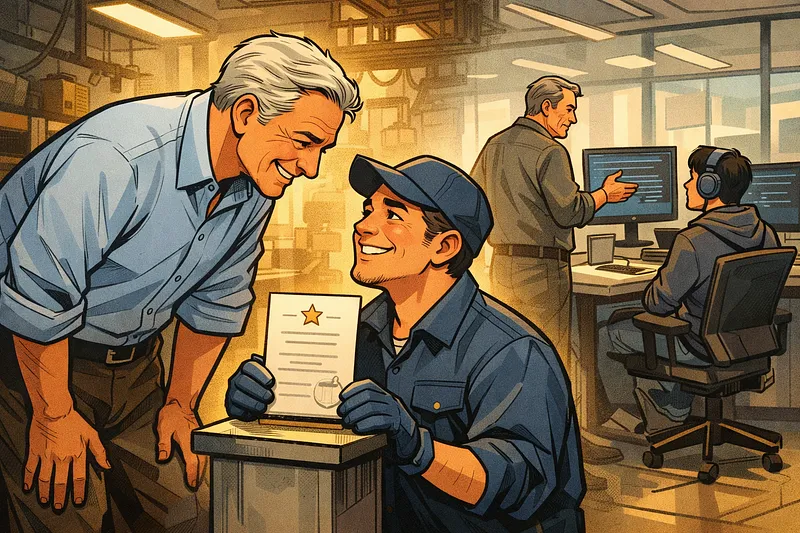
Each line worker who had implemented an improvement idea that year had prepared a single piece of paper — same format across the entire plant, so it was easy to digest quickly. As the executive walked down the production line, each worker with an implemented idea stood ready with a small pedestal displaying their paper. The format was simple: before state, after state, what they changed, and in the top right box — always the same spot — the impact. Dollars saved per year. Man-hours reduced.
The executive spent a few minutes with each one. Asked questions. Showed genuine interest. And then said something that would seem trivially simple but wasn’t: “Good job.”
The look in those line workers’ eyes — I’m not being dramatic here — was something I won’t forget. This wasn’t their supervisor patting them on the back. This was someone at the very top of the organisation, someone whose time was worth thousands of dollars per hour, choosing to spend it learning about their contribution.
And here’s the clever part: as the executive toured his various plants, he was collecting these stories. When he visited another facility, he could say, “You know, at the Thailand plant, they tried something similar with their assembly line. You should talk to them.” He was turning individual recognition into organisational learning.
The Seniority Multiplier
This brings us to an uncomfortable truth that most leadership training glosses over: the level of seniority matters enormously when recognition is given.
If your direct manager tells you “good job,” it feels nice. Expected, even. It’s their job to notice your work.
If the CEO of the company tells you “good job,” you remember exactly where you were standing when it happened. You tell your spouse about it that evening. You mention it in your next therapy session as evidence that maybe you’re not an imposter after all.
This isn’t ego — it’s basic psychology. Recognition from someone who has thousands of demands on their attention signals that your contribution was significant enough to cut through all that noise. The scarcity of their attention makes the recognition more meaningful.
As the business writer Ken Blanchard put it, “Feedback is the breakfast of champions.” But I’d add: it matters enormously who’s serving that breakfast. A compliment from the executive chef lands differently than one from the sous chef, even if the words are identical.
This creates both an opportunity and a responsibility for senior leaders. Your recognition is disproportionately valuable precisely because your time is limited. Use it intentionally. A five-minute conversation with an individual contributor can create more motivation than a month of standard management practices.
Leading from the Trenches, Not the Ivory Tower
But here’s where it gets uncomfortable: you can’t recognise work you don’t understand.
One of the failure modes I see repeatedly in engineering leadership is the executive who’s so far removed from the actual work that their recognition feels hollow. “Great job on that microservices migration!” they say, having no real understanding of why it was difficult or what trade-offs were made.
The physicist Richard Feynman had a beautiful concept he called “cargo cult science” — going through the motions of scientific rigour without understanding what makes science actually work. We have the same problem with recognition. Cargo cult recognition. The forms are observed, the words are said, but something essential is missing.
The antidote is staying in the trenches — at least occasionally.
If you’re an engineering leader, do some engineering. Not enough to block your team or create dependency on you, but enough to feel the same pain your people feel. Enough to understand why that particular bug fix was actually impressive. Enough to recognise good work not because someone told you it was good, but because you have the technical context to evaluate it yourself.
When you demonstrate to your team that you’re “in the trenches with them” — not managing from an ivory tower but actively participating in the craft — two things happen. First, your recognition gains credibility because you clearly understand what you’re recognising. Second, you model the behaviour you want to see: technical leaders who stay technical, who don’t lose touch with the reality of the work.
There’s a reason the most respected generals in history were the ones who led from the front. Not because it was strategically optimal — it often wasn’t — but because it demonstrated something words couldn’t: shared risk, shared understanding, genuine respect for those doing the hardest work.
The Two-Way Street of Behavioural Reinforcement
Let’s be honest about something: calling out the behaviour you want to see in a positive light is how you encourage more of it. That QA manager understood this instinctively. Every one-on-one was an opportunity to shape behaviour through specific, constructive feedback.
But there’s a flip side, and it requires more care.
Calling out behaviour you don’t want to see is also necessary — but dangerous. Do it wrong, and you create fear. Fear leads to hiding problems instead of surfacing them. Fear leads to engineers covering up mistakes instead of learning from them. Fear leads to exactly the opposite culture from what you intended.
The key is specificity and privacy. Positive recognition can be public — in fact, public recognition often multiplies its impact. Negative feedback should almost always be private, specific, and focused on the behaviour rather than the person.
When that QA manager told his direct report “here’s the exact moment you should have spoken up,” he wasn’t saying “you’re a bad employee.” He was saying “you had something valuable to contribute, and I need you to contribute it next time.” The framing matters.
What Gets Recognised Gets Repeated
We’re approaching 2,000 words, and I haven’t given you a single tool to install or metric to track. That’s intentional.
Recognition isn’t a system you implement. It’s a muscle you develop. It requires noticing the things worth recognising, having the context to understand why they matter, and taking the time to actually say something about them.
As the management theorist Peter Drucker observed, “What gets measured gets managed.” But the corollary is equally true: what gets recognised gets repeated. If you only recognise shipped features, you’ll get engineers who ship features — and nothing else. If you recognise thoughtful code reviews, mentorship, documentation, speaking up in meetings, cleaning up technical debt — you’ll get those things too.
Your recognition patterns are your culture, in practice. Not the values on your website. Not the mission statement in your onboarding deck. What you actually notice and comment on.
The Bottom Line
Recognition isn’t about making people feel good — though that’s a welcome side effect. It’s about signal amplification. Every time you recognise a behaviour, you’re sending a message to those present about what matters. Every time you fail to recognise a behaviour, you’re sending an equally clear message.
That manager who spent his one-on-ones coaching people to speak up wasn’t being nice. He was building a team capable of catching problems early, challenging assumptions, and making better decisions collectively. The executive walking the factory line wasn’t engaging in empty ritual. He was creating a culture where continuous improvement was worth pursuing because someone important would notice.
The question isn’t whether recognition is important — of course it is. The question is whether you’re being intentional about it. Whether you’re recognising the behaviours you actually want to see more of. Whether you’re using your hierarchical position to amplify that recognition. Whether you’re staying close enough to the work to know what’s worth recognising in the first place.
Your best engineers aren’t posting on LinkedIn because they got a better offer elsewhere. They’re posting because they felt invisible. Because the work they poured themselves into went unnoticed. Because nobody with any seniority ever took five minutes to understand what they’d accomplished and tell them it mattered.
That’s fixable. But you have to actually do it.
Now, if you’ll excuse me, I need to go write some overdue thank-you messages. There are at least three people on my team who did something impressive this month that I haven’t acknowledged yet — and based on everything I just wrote, that’s entirely on me.