
The Alternative to the Feature Factory: Why Problems Beat Features
“If I had an hour to solve a problem, I’d spend 55 minutes thinking about the problem and 5 minutes thinking about solutions.” — Albert Einstein
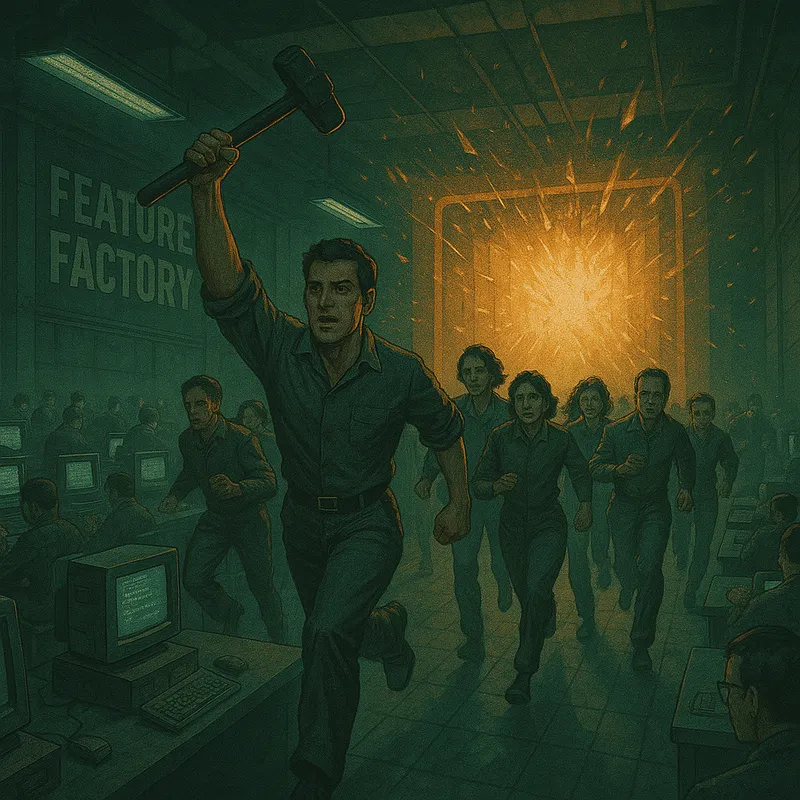
Einstein wasn’t a software engineer, but he understood something that we in tech often forget: the problem matters more than the solution. Yet here we are, decades into the digital age, and most engineering teams are still operating like feature factories, churning out specifications like widgets on an assembly line.
The Feature Factory Trap
You know the scene. Sprint planning rolls around, and there it is: a backlog stuffed with features, each one meticulously specified down to the pixel. “Build feature X to specification Y.” Check. Ship. Next. It’s comfortable, measurable, and completely missing the point.
I’ve sat in those meetings. Hell, we’ve all sat in those meetings. The ones where success is measured in story points delivered rather than problems solved. Where engineers become typists, translating requirements documents into code with all the creativity of a photocopier.
As Henry Ford once said, “If I had asked people what they wanted, they would have said faster horses.” Ford understood that customers articulate desires, not solutions. They experience problems, not feature requirements.
Flipping the Script: The Problem Lens
Let’s talk about what happens when you flip this model on its head. Instead of “Build a new checkout flow with these 15 specifications,” you get “We don’t have a good enough conversion rate on our booking funnel.”
See the difference? One tells you what to build. The other tells you what to solve.
When you look at everything through a problem lens, three transformative things happen:
1. Outcomes Trump Outputs
“Improve conversion rate” has teeth. You can measure it, optimize for it, and know definitively whether you’ve succeeded. “Build feature X”? That only measures whether you typed the code. It’s the difference between a chef who cooks to nourish and one who just follows recipes.
We’ve all been in situations where we delivered exactly what was asked for, only to watch it fail spectacularly in production. The feature worked perfectly. It just didn’t solve the problem.
2. Creativity Returns to Engineering
When you’re solving problems rather than implementing specifications, suddenly there’s room to think. That conversion rate issue? Maybe it’s a UX problem. Maybe it’s technical latency. Maybe it’s the pricing structure. Hell, maybe the solution is to remove features rather than add them.
“The significant problems we face cannot be solved at the same level of thinking we were at when we created them,” Einstein reminds us. Yet feature specifications lock us into predetermined solutions before we’ve even understood the problem space.
3. Engineers Become Partners, Not Resources
Here’s where it gets interesting. When engineers understand the “why” behind their work, they stop being implementation resources and become problem-solving partners. They ask better questions. They propose alternative solutions. They actually give a damn about the outcome.
The Uncomfortable Truth About Ownership
Now, let’s address the elephant in the room. I’ve heard engineers say it: “It was easier before when I just had to deliver 22 story points. Now you expect me to deliver business results?”
Yes. Yes, we do.
And you know what? It’s harder. It’s scarier. But it’s also infinitely more satisfying when you ship something that actually moves the needle rather than just moves tickets across a board.
Cross-Functional Reality Check
Here’s where theory meets reality. To solve real problems, you need real expertise. Not just engineers, but UX designers, security experts, sometimes even legal counsel. I’ve worked on teams that brought in legal experts for an entire quarter because we were tackling problems in heavily regulated spaces.
The key is bringing in the right expertise when you need it. We try to do this on-demand rather than arbitrary schedules. Nothing kills momentum like hearing “The UX designer only works with us on Tuesdays” when you need a critical decision on Wednesday.
The A/B Testing Reality
Let me give you a concrete example. When you’re running A/B tests and hit an allocation bias problem, you need someone who understands both the code implementation AND how users interact with the system. Try splitting that knowledge between an engineer and a product owner, and watch how quickly finger-pointing replaces problem-solving.
This reminds me of a story from my semiconductor days. We had separate hardware and software teams. When problems arose, hardware blamed software, software blamed hardware, and nothing got solved. The same thing happens with A/B tests when you split ownership. You need people with end-to-end knowledge to troubleshoot effectively. Not deep expertise in everything — just enough to understand the connections. That’s the T-shaped professional concept in action.
“In the middle of difficulty lies opportunity,” Einstein said. The difficulty of taking ownership of business results rather than feature delivery is real. The opportunity is to do work that actually matters.
Making the Shift
So how do we move from feature factories to problem-solving teams? Start here:
Reframe your backlog. Every item should start with a problem statement, not a feature description.Measure what matters. Stop celebrating feature launches. Start celebrating problem resolutions.Enable your teams. Give them access to the expertise they need, when they need it.Embrace the discomfort. Yes, it’s harder to own business results than story points. That’s precisely why it’s worth doing.
The Bottom Line
Warren Buffett once said, “Price is what you pay. Value is what you get.” In our world, features are what you build. Solutions are what you deliver.
The alternative to the feature factory isn’t just a different way of working — it’s a different way of thinking. It treats engineering teams as creative problem-solvers rather than sophisticated typists. It measures success in customer outcomes rather than code commits.
Is it more challenging? Absolutely. Is it less comfortable than checking off feature requirements? Without question. But if you’re in this field to make a real impact rather than just make a living, there’s really no alternative.
After all, nobody remembers the team that delivered 500 story points. They remember the team that solved the problem.
What problems is your team solving this quarter? Or are you still counting features? Drop me a line or leave a comment— I’d love to hear how you’re making the shift from factory to problem-solving.