
The Math That Doesn’t Add Up: Why Collective Ownership Beats Individual Productivity
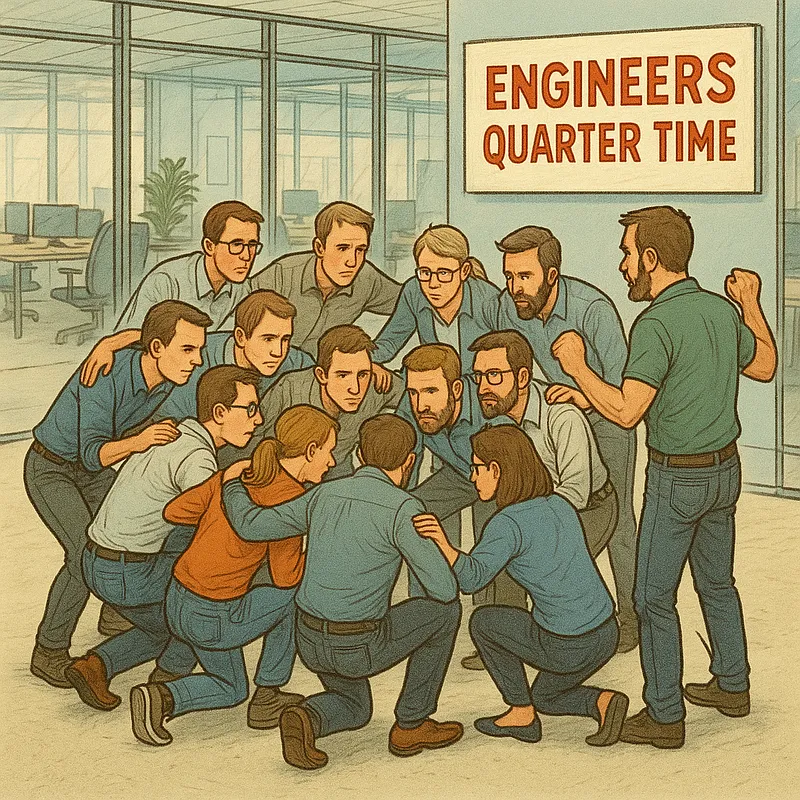
Picture this: You’re in a sprint planning meeting, and someone suggests having three engineers work together on a feature for two days instead of having one engineer tackle it solo over three days. The project manager’s eye starts twitching. The bean counters are reaching for their calculators. “That’s 6 engineer-days versus 3!” they exclaim. “It’s basic math!”
Well, here’s the thing about this type of basic math in software engineering — it’s about as reliable as Bangkok traffic predictions during rain season.
When 3 + 3 + 3 Actually Equals Less Than 6
There’s a quote from Vince Lombardi that’s stuck with me throughout my career: “Individual commitment to a group effort — that is what makes a team work, a company work, a society work, a civilization work.” Now, Lombardi was talking about American football, but he might as well have been describing modern software teams.
You see, we’ve been conditioned to think about engineering productivity like we’re running a factory assembly line. One widget per person per hour. Maximize individual output. Keep everyone busy. But software engineering isn’t widget manufacturing — it’s more like conducting an orchestra where everyone needs to play the same symphony.
When we have three engineers collaborating on a feature, something magical happens that the spreadsheet warriors miss entirely. Knowledge gets distributed across the team instantly. Code review becomes a real-time conversation rather than a bottleneck three days later. Design decisions get challenged and improved on the spot, not during the inevitable refactoring session two sprints down the line.
The Bus Factor Isn’t Just About Buses
I’ve learned this lesson the hard way. I’ve seen too many features become the domain of a single engineer — what we lovingly call “tribal knowledge” until that engineer takes a vacation to Koh Samui, and suddenly nobody knows why the booking flow behaves strangely on Tuesdays.
As Maya Angelou once said, “If you don’t like something, change it. If you can’t change it, change your attitude.” We changed our attitude about collaboration. Instead of seeing multiple engineers on one task as inefficiency, we started seeing single-engineer ownership as a risk we couldn’t afford.
The whole team approach means everyone’s accountable for the project’s success, not just their individual tickets in Jira. When you shift from “I finished my tasks” to “we delivered value to our partners,” everything changes. Context switching becomes the enemy, not collaboration.
North star metrics work well here too, the statement can change to something like “I delivered 100 Incremental Bookings per Day to the company this sprint” is very impactful, see my other post about this in my Product Engeering Series.
T-Shaped People in a Flat World
We talk a lot about T-shaped professionals — people with deep expertise in one area but broad knowledge across disciplines. Think of it like being a specialist chef who also understands how the entire restaurant operates. You can prepare an exceptional pad thai, but you also know when the front-of-house is slammed and maybe it’s time to simplify the evening specials.
This isn’t about everyone becoming a generalist. We still need deep expertise. But when your frontend engineer understands the database implications of their API calls, and your backend engineer appreciates the UX impact of a 200ms delay, magic happens. Teams become self-sufficient instead of constantly throwing work over the wall and hoping someone else catches it.
Measuring What Actually Matters
Here’s where we need to have an uncomfortable conversation about metrics. I’ve sat in too many retrospectives where teams proudly announce they completed 47 story points, while our partners are still waiting for the feature that was supposed to solve their problems.
As Peter Drucker famously said, “What gets measured gets managed.” The problem is, we’ve been measuring the wrong things. Story points completed, individual velocity, resource utilization — these are tools, not goals. They’re like measuring how fast you’re driving without caring if you’re headed in the right direction.
The question that should matter after every sprint isn’t “How many points did we burn down?” It’s “What value did we deliver to our partners?” When teams start asking that question, behavior changes naturally. Features don’t get abandoned at 90% complete. Technical debt gets addressed because it impacts delivery speed. Quality becomes everyone’s concern, not just QA’s.
Single Focus Until It Ships
One of the hardest mindset shifts we’ve made is moving from task-first to feature-first thinking. When you finish your piece of a feature but the feature isn’t ready for production, the instinct is to start working on something else. “Stay busy,” the old productivity gods whisper. “Maximize your individual output.”
But context switching is the productivity killer we never see coming. It’s like trying to read a technical specification while someone keeps changing the music every thirty seconds. Your brain never gets the chance to maintain deep focus.
Instead, when your individual work is done but the feature isn’t shipping, you help get that feature across the finish line. Maybe that means helping with testing. Maybe it’s improving documentation. Maybe it’s pair programming with a colleague who’s stuck. The entire team stays focused on getting that feature running in production before anyone moves to new work.
The Manager as Teacher Revolution
The command-and-control management style died somewhere around the time we realized that the people closest to the code usually have the best solutions. Modern engineering managers aren’t directors; they’re gardeners. They create the conditions for teams to flourish, remove obstacles, and then get out of the way.
As Lao Tzu wrote, “A leader is best when people barely know he exists.” When teams are self-managing and collectively solving problems, that’s not a sign of weak leadership — it’s a sign of excellent leadership that’s enabled autonomy and accountability.
The Paradox That Works
So yes, having three engineers spend two days on something instead of one engineer spending three days looks inefficient on paper. But in the real world of software engineering, where knowledge sharing prevents future headaches, where collaboration catches problems early, and where collective ownership reduces risk, that “inefficient” math starts making perfect sense.
We’re not optimizing for cost per developer hour. We’re optimizing for delivering value to our partners faster and more reliably. And sometimes, the best way to go fast is to go together.
The next time someone questions why you have multiple engineers collaborating on a single feature, remind them that software engineering isn’t about maximizing individual productivity — it’s about maximizing team effectiveness. The math might not add up in the spreadsheet, but it works beautifully in production.
Trust your teams to find the collaborative patterns that work best for their context. After all, they’re the ones who have to live with the code they write.
What collaborative approaches have worked best for your teams? I’d love to hear how you’ve made the “inefficient” math work in your organization.