
Your Meetings Are Broken (Yes, Even the In-Person Ones)
Or: Why Being in the Same Room Doesn’t Mean You’re in the Same Conversation
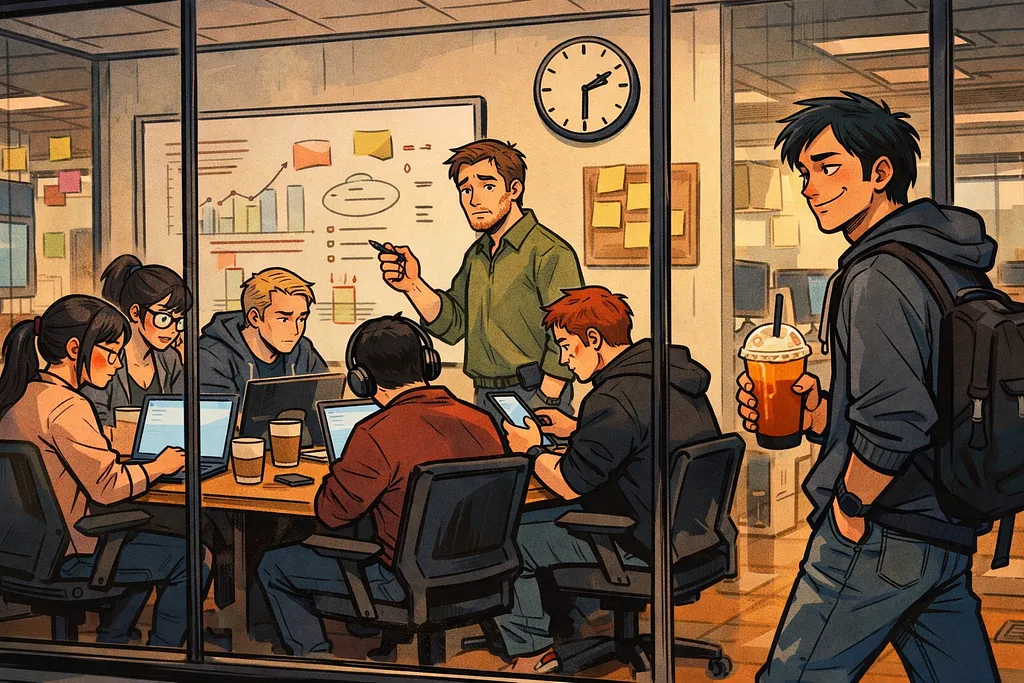
It was 2:30 on a Wednesday, and Somchai had been talking for forty seconds before he realised nobody was listening. Not in the dramatic, cinematic way — nobody stormed out, nobody rolled their eyes. It was quieter than that. Namfon’s fingers hadn’t stopped moving across her keyboard since the meeting started. Toey was scrolling through something on his phone under the table, the glow catching the edge of the vinyl flooring. The room on level eight smelled like the ghost of someone’s afternoon coffee and the particular staleness of air conditioning that’s been recycling the same air for three hours. Somchai paused, mid-sentence, and in the silence you could hear the faint percussion of Slack notifications from three different laptops.
That silence was the sound of a meeting dying. Not because the topic didn’t matter — it did — but because everyone in the room had already decided, unconsciously, that being present and paying attention were two different things. And nobody had told them they were wrong.
I wrote recently about how async and remote work are quietly eroding engineering velocity. But here’s the uncomfortable follow-up: you can have every single person in the same room, at the same time, in the same building — and still get the exact same dysfunction. It’s just a little bit more obvious to the observer in person. Cameras-off energy isn’t a remote work problem. It’s a discipline problem. And it follows you through the office door.
The Laptop Disease
Let’s start with the most obvious and most common way we fail at in-person meetings: we let people bring their laptops and then act surprised when they use them.
You know the scene. Eight people in a room. Six laptops open. Half the room is “taking notes” — which is corporate shorthand for answering Slack messages, triaging emails, and occasionally glancing up when their name is mentioned. The meeting organiser is presenting something they spent hours preparing, speaking into a room full of people whose attention is split between the conversation that matters and twelve conversations that don’t.
Peter Drucker put it bluntly decades ago: “Meetings are by definition a concession to deficient organisation. For one either meets or one works. One cannot do both at the same time.” He said that in the 1960s, before laptops, before smartphones, before Slack. The principle hasn’t changed. What’s changed is that we’ve given everyone a portal to their entire working life that fits on the table in front of them, and then we act shocked when they disappear into it.
I have zero tolerance for this. And the way I handle it is deliberate.
When I see laptops open in a meeting I’m running, I’ll say something like: “If anyone is in a war room right now and you need to be on your laptop, please leave the meeting and we can reschedule if needed. A war room is more important than this meeting.”
That single sentence does three things. First, it acknowledges that there are legitimate reasons to be distracted — a production incident outranks almost everything. Second, it establishes that if you’re not in a war room, there’s no legitimate reason for the laptop to be open. And third, it does both of those things without making anyone feel attacked. You’re not saying “put your laptops away.” You’re saying “the only thing more important than this meeting right now is a production incident.” The subtext lands. The laptops close.
If you can get this far, you’ve won most of the fight.
The Derailers and Tangent Explorers
Once the laptops close and people are actually paying attention, you’ll discover a new problem — one that was always there but was masked by the distraction. Some people talk. A lot. About things that aren’t the purpose of the meeting.
You know who they are. It’s usually the same person every time. They’ll latch onto a tangentially related topic and run with it for ten minutes while everyone else in the room starts calculating how much of their afternoon is evaporating. The tangent might even be interesting. It might even be important. But it’s not why you’re all sitting in this room right now, and every minute spent on it is a minute stolen from the thing that is.
The trick is redirection without humiliation. When someone has been going on for too long about something that’s drifted from the meeting’s purpose, I’ll say: “This is an important topic you’ve hit on — it’s big enough that it needs its own meeting.” That framing matters. You’re not telling them to shut up. You’re telling them their point is so significant it deserves dedicated time rather than being crammed into someone else’s agenda. They feel heard. The meeting stays on track. Everyone wins.
But here’s what I’ve noticed: this problem actually gets worse once you’ve solved the laptop problem. When people were half-distracted by their screens, the derailers were just background noise that everyone could tune out while answering emails. Once you’ve got genuine attention in the room, every tangent is felt more acutely. That’s a good problem to have. It means people are actually engaged enough to notice that the conversation has drifted.
Come to meetings with agendas. Time-box your topics. These aren’t revolutionary ideas, but they’re the difference between a meeting that respects people’s time and one that treats it as an infinite resource. Which brings us to the bigger disease.
The Meeting Tax
The basketball coach John Wooden — who won ten NCAA championships in twelve years — was famously meticulous about practice time. He planned every minute of every practice session, down to the specific drills and their exact duration. When asked why, his answer was simple: “If you don’t have time to do it right, when will you have time to do it over?” He understood that unstructured time isn’t free time — it’s wasted time wearing a productive disguise.
The same principle applies to your meeting culture, except we’ve somehow accepted the opposite. We schedule meetings with the casual abandon of someone who’s never looked at a calendar and asked, “when exactly is the work supposed to happen?”
Too many meetings is probably the single most common complaint from engineering teams practising Scrum, and it’s a legitimate one. Cal Newport’s research on deep work makes the case convincingly: engineers need at least two to three uninterrupted hours each day — more if possible — to achieve the flow state that’s essential for complex problem-solving. Every meeting is a context switch. Every context switch has a cost. And that cost compounds.
In an office setting, the tax is even steeper than remote. A thirty-minute remote meeting costs you roughly thirty minutes — you mute, you join, you leave, you’re back at your desk. A thirty-minute in-person meeting costs you the walk to the room, the five minutes of settling in, the two minutes of small talk, the meeting itself, the walk back, and the mental re-entry into whatever you were working on before. That thirty-minute meeting just became forty-five minutes of lost productivity. Multiply that by four meetings a day and you’ve burned three hours — exactly the minimum uninterrupted block your engineers need and now don’t have.
The irony cuts both ways, though. One of the advantages of in-person meetings is that they’re harder to ignore. In a remote setting, it’s easy to join a meeting on mute, turn off your camera, and continue working — which is exactly the problem I wrote about in my previous post on async dysfunction. People attend without attending. They’re present without being present. In-person meetings make that harder, which is why they’re more effective when done right — but also why doing them wrong is a bigger sin. You’ve physically removed someone from their desk. If the meeting isn’t worth that cost, you’ve just stolen their time with nothing to show for it.
Practices That Actually Work
Here’s the guidance I give my teams. Some of it applies specifically to in-person work, some of it works regardless of where you’re sitting. All of it is designed around one principle: your engineers’ time is the most valuable resource you have, and every meeting should earn its place on their calendar.
No meetings after lunch. This is the single highest-impact change you can make. Engineers need those two to three uninterrupted hours, and the afternoon is where they happen. Protect that time like it’s production infrastructure — because in a very real sense, it is. Your engineers’ ability to think deeply is what produces the code, the architecture, the solutions. Meetings produce alignment, decisions, and shared context. Both matter. But if you have to choose which gets the prime real estate, the deep work wins.
Sprint planning days might be the exception — you might need one day per sprint where this rule bends. But one day, not five. If your teams can’t contain their ceremonies to a single day, you have a ceremony problem, not a scheduling problem.
Getting other teams to respect this boundary is harder. You can’t control what other directors schedule. But you can start with your own area and lead by example. And here’s a practical tip: use the “propose new time” feature in your calendar tool to actively push afternoon meetings to the morning. Every single time. It sends a signal, and signals compound.
If mornings are genuinely impossible for some recurring meeting, push it to 5 PM. The point isn’t “never meet in the afternoon” — it’s “protect the core working hours between lunch and the end of the day for actual engineering work.”
Default meeting time is thirty minutes. Avoid scheduling hour-long meetings at all costs unless you genuinely cannot achieve the purpose in less time. Shorter meetings do three things: they force people to arrive on time because they know there’s no buffer, they encourage efficiency because everyone knows the clock is ticking, and they push attendees to get to the point.
Parkinson’s Law states that work expands to fill the time available for its completion. Give someone an hour for a discussion that needs twenty minutes, and they’ll use the hour. Give them thirty minutes and watch how quickly people learn to be concise.
And here’s the part nobody does: if a meeting finishes early, leave. Don’t fill the remaining time with tangential discussion because you’ve got the room booked. Give people their time back. Every minute you return to someone’s calendar is a minute of trust you’ve built.
Review the purpose of every meeting. Before scheduling a meeting, ask yourself: could this be a Slack message? Could this be an email? Could this be a five-minute conversation at someone’s desk? If the answer to any of those is yes, do that instead. Meetings should be reserved for things that genuinely require synchronous, multi-person discussion — decisions that need debate, problems that need collaborative problem-solving, alignment that can’t be achieved through text.
Establish clear agendas and goals for every meeting. If you can’t articulate why this meeting exists and what success looks like in two sentences, you’re not ready to schedule it.
Combine meetings with the same attendees. If you have two meetings that require the same group of people, schedule them back-to-back in the same room. This isn’t just efficiency — it’s respect. You’re saving everyone a context switch, a walk, and the cognitive overhead of re-engaging. If the first meeting ends early, you can start the second one early and give people back even more time.
We did exactly this with project progress meetings in my area. We had six separate biweekly meetings — one per project, thirty minutes each. That’s three hours of meetings every two weeks, spread across different time slots, each one essentially a per-team session with me and a few senior managers as the constant attendees. We consolidated them into a single ninety-minute session. Everyone comes. Not only does it mean one meeting instead of six — and we usually finish early — but it created a side benefit nobody anticipated. Other managers and engineers hear what’s happening across projects they’re not directly involved in. They hear the feedback I give to other teams about how they’re presenting, about the way they’re framing progress, about what good looks like. That cross-pollination of context and standards doesn’t happen when every project is a private thirty-minute bubble.
Use shared calendars to identify overlapping attendees. Look for the patterns. If the same five people are in three separate thirty-minute meetings this week, consider whether one consolidated session could cover all three topics — and whether the people who aren’t in all three might actually benefit from hearing the others.
The Uncomfortable Truth
Here’s what nobody wants to say out loud: most meetings exist because someone didn’t do their job properly the first time.
Unclear requirements generate “clarification meetings.” Lack of documentation generates “knowledge sharing meetings.” Poor communication generates “alignment meetings.” Absent decision-making generates “discussion meetings” that produce no decisions and spawn follow-up “decision meetings” that produce more discussion.
Drucker saw this clearly: “Meetings are a symptom of bad organisation. The fewer meetings, the better.” He wasn’t being glib. He was pointing at the root cause while everyone else was treating the symptoms.
The best engineering teams I’ve worked with have fewer meetings, not more. Not because they communicate less, but because they communicate better. They write things down. They make decisions and document them. They use async channels for async-appropriate topics. And when they do meet — when they actually pull people into a room and ask for their undivided attention — the meeting has a purpose, an agenda, a time box, and an outcome. It earns the time it takes.
The Bottom Line
Bad meetings aren’t just annoying. They’re expensive. They erode trust, they destroy focus, they teach your best engineers that their time isn’t valued, and they create a culture where being busy and being productive are treated as the same thing.
Fix the laptops first — that’s your quick win. Then fix the derailers. Then fix the volume. Then fix the structure. Each layer you address makes the next one easier, because what you’re really building isn’t a meeting policy. You’re building a culture that respects attention as a finite resource.
As Drucker put it with his characteristic precision: “Until we can manage time, we can manage nothing else.” Your meetings are where your team’s time goes to either compound into results or evaporate into heat. Right now, most of the energy in that room is becoming heat.
Now, if you’ll excuse me, I have a meeting in ten minutes. It’s supposed to be thirty minutes but I have a feeling it’ll run to an hour. I should probably practice what I preach and do something about that.